
Wonderful information regarding Dementia and Elder care shared by Gerontology and Dementia Expert Mr. Sailesh Mishra, Founder of Silver Innings and A1Snehanjali on Granthali Pratibhangan Youtube Channel.
Showing posts with label Dementia Home. Show all posts
Showing posts with label Dementia Home. Show all posts
Thursday, March 19, 2026


Saturday, April 1, 2023
Podcast: Understand Dementia
Dementia is progressive brain disorder and we need to understand it in simple language to manage people with Dementia. Caregivers stress needs to be talked about. Know more about Tips and some solutions to counter Dementia and Alzheimer's.
 |
| https://open.spotify.com/episode/0ZNg4jPukNiycaWFcirUwf?si=ezBmzUV1S2SYiyvg6PeOnw |
Listen to my podcast Understand Dementia: click at this link : https://open.spotify.com/episode/0ZNg4jPukNiycaWFcirUwf?si=B0OlODCRR6Cda0Cp2s8xeg
#podcast #SeniorCitizens #Eldercare #Elders #World # #oldage #olderadults #India #seniors #seniorliving #empathy #Family #Relationship #saileshmishra #spotify #Dementia #Silverinings
Sunday, October 16, 2022
Anvayaa organizes a Fire Side Chat on Dementia Care
Anvayaa, India’s first and only IoT and AI tech-based start-up platform providing Companionship and Care to the elders hosted a Fireside chat on World Alzheimer’s Day themed ‘Know Alzheimer’s Know Dementia – Post diagnosis support’. The panel was attended by Dr. Sanjay R Kumawat, Director, Insight Mind Care Center, Thane, Consultant Psychiatrist, Mr. Sailesh Mishra, Founder, Silver Innings Group, Dr. Manish Chhabria, Consultant Neurology, Sir H.N. Reliance Foundation Hospital & Research Centre, and Mr. Prashanth Reddy, Founder, and Managing Director, Anvayaa Kin-Care Pvt Ltd along with other guests and senior citizens. The chat focused on an insightful discussion on challenges faced by caregivers and family in diagnosis and post-diagnosis care for elders with Dementia and the supportive eco-system required for effective management of such elders.
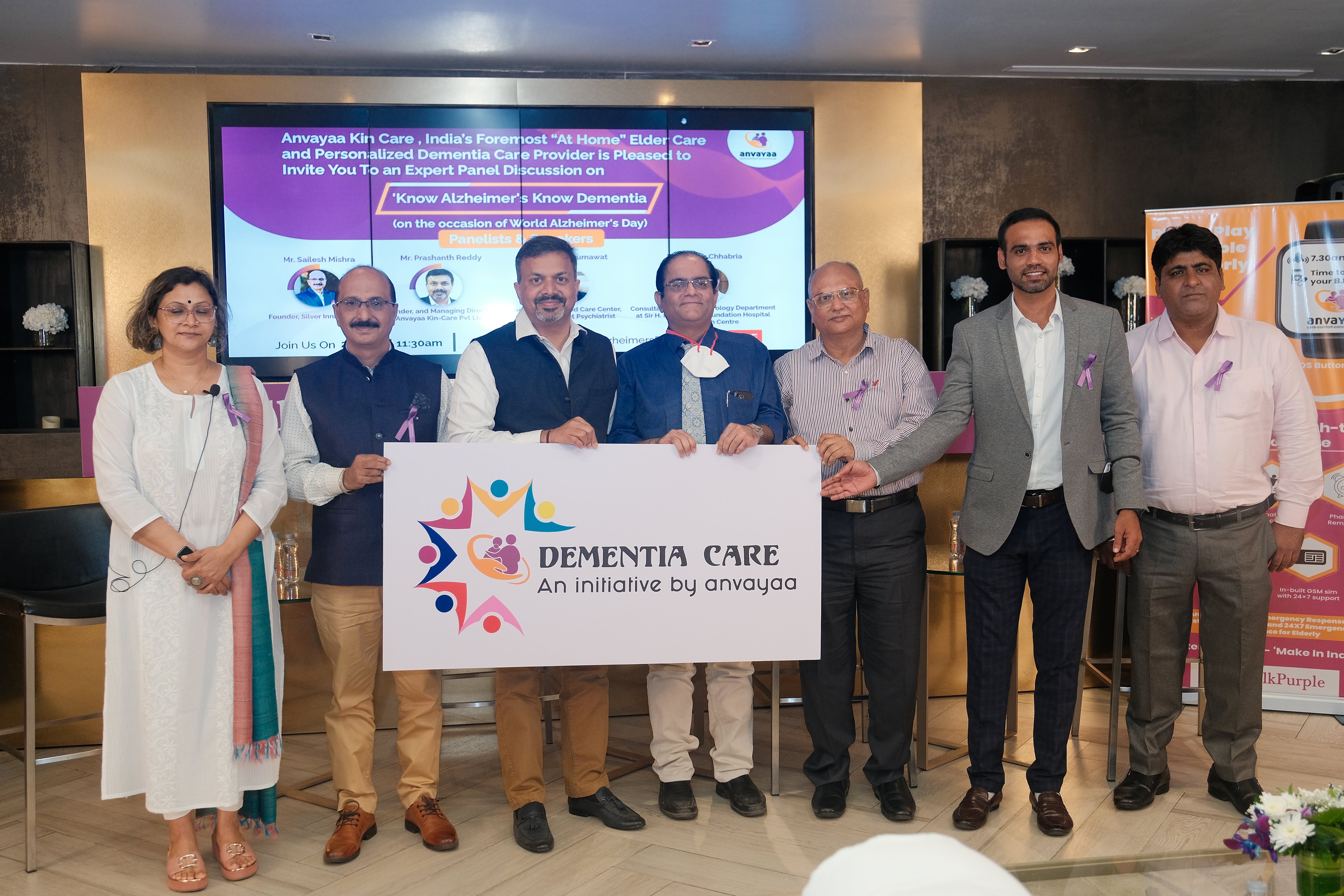
‘Dementia’ is generally considered a part of aging; however, it does not occur naturally. Alzheimer’s Disease is the most common factor causing Dementia. As per the DementiaInIndia & #LASI Wave-I report, around 5.3 Million Indians were affected by #Dementia in 2020. This number is likely to go up to a staggering 14 Million by the year 2050. Besides the diagnosis, post-diagnosis care, caregiver burnout, unique treatment plan, and unique challenges in taking care of elders with dementia. A personalized treatment plan enabling regular monitoring and tracking of the elderly is necessary because it manifests differently in different people and across the stages of progression. As the condition of the elderly worsens without adequate care and professional support, the whole family is bound to suffer great stress and pain.
Anvayaa’s one-of-a-kind #DementiaCarePlans are designed to reduce caregiver fatigue and the frustration the family goes through. Anvayaa has repeatedly shown that despite the lack of a cure for dementia, there is still a great deal that is possible to help people with dementia. In comparison with other conditions faced by seniors, Alzheimer’s disease and dementia have very different symptoms and results. The pathogenesis of dementia is a progressive decline in cognitive function (memory, reasoning, decision-making, judgment, etc.), ultimately affecting bodily function. Dementia affects every aspect of a senior’s life, making specialized and personalized care even more essential. Although every case of dementia is unique, here are some things that may happen to a senior with these conditions’ general loss of memory, language, and decision-making abilities, dementia can cause other symptoms. These include changes in mood, such as increased irritability, depression, and anxiety. This requires compassionate and specialized training of caregivers to deal with the elderly. Early detection and diagnosis of Dementia can greatly help in slowing down the rate of deterioration and immensely helps in providing a much better quality of life for our beloved elders and their families.
According to Mr. Prashanth Reddy, Founder and Managing Director of Anvayaa Kin-Care Pvt Ltd, said, “We are happy to associate with Silver Innings, Dr. Sanjay R Kumawat, Clinical Psychiatrist, and Dr. Manish Chhabria, Consultant Neurology to host this fireside chat to spread awareness about Alzheimer’s disease and dementia on the occasion of World Alzheimer’s Day. Our aim is to identify the critical challenges faced during post-diagnosis care of people with dementia. We have also developed ‘AI Enabled at Home Anvayaa’s Dementia Care Plan’ for compassionate care through a team of specially trained ‘Care Specialists’ who are guided by a team of qualified clinicians to provide customized support to persons with dementia and help the families to prevent burnout. The enlightening session today, will help Anvayaa further improve the services and help elders live a dignified life. We firmly believe that although Alzheimer’s cannot be reversed, however with strategic interventions along with the trust and support of the elders and their families we can definitely help to delay the progress. We have already been able to positively improve the quality of life of persons with dementia in the last few months and hope to continuously improve our services and help more elders with dementia.”
Speaking on the occasion Mr. Sailesh Mishra, Founder, Silver Innings Group “It is a pleasure to associate with Anvayaa Kin Care and Dr. Sanjay R Kumawat for this necessary dialogue. As the world is progressing Dementia & Alzheimer’s are turning into a new Pandemics , and if India does not wake up then it will be difficult to handle. These diseases not only affect people with Dementia but also is a social, economic, and psychological burden on millions of families and caregivers.
Adding to this Dr. Sanjay R Kumawat, Director, Consultant Psychiatrist, Insight Mind Care Center said, “It is high time that we sensitize the community about Alzheimer’s disease and Dementia. These conditions are difficult to identify and diagnose. The post-diagnosis care is even more challenging both for the patient and the family. With the present lifestyle, it is time to be prepared for caring and understanding the patient with dementia. We should also make efforts to avoid the disease by adopting a healthy lifestyle. I would like to thank the entire team of Anvayaa to come forward and organize such an enlightening discussion on Dementia Care.”
Anvayaa has extensively grown and presently serves different services such as companionship, caretakers, tech instruction for elders, visiting temples or malls-assisting the elderly with shopping and other errands through our care managers. With technology-driven initiatives, Anvayaa guarantees senior residents with services including crisis care and social commitment. Over the past 6 years, Anvayaa has handled 350+ medical emergencies and provided immediate logistic support to the elderly to get access to healthcare in time as a result of which Anvayaa was able to save 97% of lives.
#Silverinnings #SaileshMishra #SeniorCitizens #Dementia #Dementiacare #Mumbai
Tuesday, January 25, 2022
Humans of Dementia - Ajay
Ajay became a part of A1Snehanjali in 2013 when he was seeking employment while working as a farmer. Ajay is 25 years old and currently works as a caregiver for people with Alzheimer’s disease. He spends his days taking care of them and tending to the needs of the residents.

Ajay has been a part of the organisation since the project was initiated in August 2013. After he started working at A1Snehanjali, he learnt about Alzheimer’s and he decided he wanted to help the people who have become the victims of such a “nirdaye” (cruel) disease. “Everyone should live a good life,” he said. “Just because they cannot eat or relieve themselves independently, it does not mean we will take away their right to live a good life.”
As a caregiver, Ajay’s job entails waking up the residents, giving them a bath, giving them their medicines, feeding them their breakfast, taking them for a walk, engaging them in group activities, changing their diapers, preparing their lunch and then taking them for a nap. He manages all their grooming activities like helping them brush their teeth, changing their clothes and trimming their nails.

Ajay shared the story of one of the initial days of his job as a caretaker. At that time, there used to be only one resident in the organisation who had a habit of wandering off. Ajay used to stay by his side all the time and follow him around. Spending all his time talking, playing and taking care of that one resident made him so attached to him that Ajay started considering him as his own family member. When asked about the challenges he faces during this job as a caregiver, Ajay laughed and replied, “It’s their anger and their violent hits.” In situations like these, he waits for a few minutes for them to calm down and then tries again.
Despite this job being physically exhausting and mentally draining, the emotional attachment that each resident has with Ajay makes this job worthwhile for him. He “feels good” even after being tired. There have been numerous days throughout the years where Ajay wants to take a leave. When the residents get to know about this news, they get anxious about how they would be spending their day without Ajay, or who would look after them and listen to them talk. And the day Ajay returns to them, they immediately become happy. Ajay says that all this love and little acts of caring they have for him touches his heart and makes him want to work harder for them.

There is one thing that, he feels, many people do not know about Alzheimer’s and dementia disease― the importance of taking care of people who are diagnosed with the condition. Many people give up on them after the diagnosis because they find looking after them to be very tiresome and taxing. Ajay strongly believes that people should not ignore the needs― physical, mental and emotional― of these people. He also thinks that as a caregiver, it is necessary to know how to handle the resident, how to calm them down and understand them and also efficiently manage their sanitation and grooming.
Whenever someone learns that he is working as a caregiver and taking care of people with Alzheimer’s, they greatly appreciate him. He promises to work for and help these people till the day he can and also hopes others would follow his lead and help these people in all the ways they can.
Ajay strongly believes "Those with dementia are still people and they still have stories and they still have character and they're all individuals and they're all unique. And they just need to be interacted with on a human level." - Carey Mulligan.
By Vansh Tibrewal
Visit Facebook page: https://www.facebook.com/HumansofDementia
Instagarm Page: https://www.instagram.com/sihumansofdementia/
#Silverinnings #HumansofDementia #dementia #Alzheimer #humanity #HumanityFirst #love #family #Instagram #A1Snehanjali #Relationship #Caregiver #Caregiving #Humans #Humanity #Caregiving #CarePartners #Touch #care #Smile
Wednesday, December 15, 2021
Humans of Dementia - Raynah Remedios
Making her father happier in his sunset years
Dementia and Alzheimer's were words
Raynah
had heard of, but could never truly comprehend. All she thought was that it perhaps
had something to do with old age. She never realised the seriousness of the
condition until it hit home and affected their lives as a family. Raynah lived
in another city so her parents would visit her for about a month every year and
she would visit them from time to time.

There would be tell-tale signs in her father’s behaviour but as all do, would pass it off as absent mindedness or forgetfulness that was part of the ageing. There was this one time, when she saw him walking about with his dark glasses on. At first she ignored it but when she saw him reading the newspaper with his dark glasses on, she asked why? When he replied, “No wonder it is so dark! I was wondering why there is no light in your house." it made her wonder but not enough to be worried.
There were other such instances, which she dismissed off, like he would misplace things regularly, repeat the same stories or ask the same questions over and over again. She recalls that her mother was upset because he hadn’t wished her and thought that he was just being mean but he actually did not remember what day it was. From not remembering names, not remembering days, years, birthdays to being unable to keep accounts, misplacing money, forgetting ATM pins, her father soon lost interest in doing the things he loved, like watching sports, movies and the news on TV. What worried Raynah more was that he stopped reading the newspaper, a ritual he had practiced religiously all his life.

The family had till then still not
realised that dementia had set in a while ago and was now progressing at an
alarming rate. When they finally took
him to get some tests done, the doctor said that he should have been brought in
five years ago. Everything quickly began to fall apart a few months after his
diagnosis, as her father started to lose control over his bodily functions and
would hide his soiled clothes in embarrassment. He used to love to eat and
never wasted food but now he was now pushing his plate aside, barely eating a
few morsels. His appetite diminished and slowly his personality started to change
as well and would not talk much to anyone. He was angry a lot more and got
aggressive when he would not be allowed to go out on his own. Her father walked
out of the house often, would wander on the streets, get on to trains and buses
and they would be forced to follow him, so he did not get lost. Raynah and her
mother soon realised that there would be no permanent solution for this
situation.
On their next visit to the doctor, the family was told that the medication was not helping and the only option was to sedate him. The continuous sleeping most of the day left him disoriented and disheartened by the side effects, so the family decided not to continue to sedate him. When Raynah realised that her mother, who was his sole care giver, could not manage the pressures of looking after him all day any more, they began to reach out to people in the hope to find support and care. Of the options available, Raynah came to the conclusion that ‘A1Snehanjali’, dementia care facility of Silver Innings was the best place to give him the 24 hour attention, assistance and after visit to the facility, they felt confident that he would be well looked after there.

The choice to put their father
in ‘A1Snehanjali’ wasn’t an easy one. It came with a guilt and disappointment
of not being able to provide the comfort he needed and having to reach out to
someone better equipped to help their father live out the remainder of his life,
away from all his loved ones. ‘A1Snehanjali’ and their team proved to be the
right choice and have not only been keeping him engaged but they have helped
him retain some of his cognitive ability too. While his memory and cognitive
and physical capabilities continue to deteriorate as the disease progresses, the
family's only solace is that he is being taken good care of and doesn’t know
what is happening. That he is happy and at peace in his own world, is now
enough for the family.
Shared by Raynah Remedios, Daughter
Edited and Complied by Hira Mehta
Courtesy: 'Remember ME - You Me and Dementia' Book https://www.amazon.in/dp/9385221051
Visit Facebook page: https://www.facebook.com/HumansofDementia
Instagarm Page: https://www.instagram.com/sihumansofdementia/
#Silverinnings #HumansofDementia #dementia #Alzheimer #humanity #HumanityFirst #love #family #Instagram #A1Snehanjali #Relationship #Caregiver #Caregiving #Humans
Sunday, December 5, 2021
Humans of Dementia - Asha
A1Snehanjali assisted living elder care home, project of Silver Innings employs several people, both men and women, as full-time caretakers for Persons with Alzheimer’s. Many of those employees work a morning to evening shift and return home, which is possible since they are local residents who have access to intra-city travel. However, many other employees come to work at the A1Snehanjali centre from nearby or far-off villages, which makes it difficult for them to travel to and fro their village every day. Thus, the organisation arranges for these employees to stay at the A1Snehanjali centre itself. While most of these employees tend to be male, there are also some female employees who stay at the centre. One such employee is Asha, a 30-year-old woman who came to work at the A1Snehanjali centre from a nearby Tribal village called Vikramgarh, District Palghar.

Vikramgarh is a remote area where the job opportunities are at a bare minimum. The major work that the community of that village performs is that of farming and other agricultural jobs. However, those jobs are seasonal and heavily dependent on the climate, which means that if it doesn’t rain enough one year, the families in the village don’t earn enough to survive. Therefore, Asha decided to venture out of the village to explore stable job opportunities in the city. This is when she came across A1Snehanjali and began working for them as a resident employee.
Before she came to A1Snehanjali, she didn’t know what Alzheimer’s disease was. Once Asha came to the centre, she learnt about the disease and what is required from her as a caretaker person with Alzheimer’s. Coming from a community that lives in a remote area, the awareness about such diseases was, and still is, extremely minimal. Even as she works here, her family and friends back home aren’t fully aware about the disease. Nonetheless, they know that Asha’s work comprises of taking care of elder people, and so they continue to give Asha their blessings for doing this good work. Along with her relatives, Asha also feels happy in the work she does and finds it worthwhile to take care of the elders with dementia.

Asha lost her husband few years ago and has 6 years old girl child, she worries about her child future and needs to work. Asha being mother and being compassionate towards her parents, helps her to care for Elders. She is Team member and works with her colleagues to make the center a better home stay for person with dementia. Her creativity with Rangoli and smile brings joy for all.
At the A1Snehanjali centre, Asha’s duties include changing the diapers of the patients, sometime making them food and feeding them, giving the resident their medicines at the respective times as well as cleaning and grooming them on a daily basis. As a caretaker, she is essentially responsible for the day-to-day activity living of the residents since she assists them in almost every task they do every single day. However, she doesn’t mind the work since there aren’t any major problems or challenges she faces. Instead, Asha finds that everything runs quite smoothly every day at the A1Snehanjali centre with support from management, making it easier and happier for both the patients and the caretakers.
By Vansh Tibrewal
Visit Facebook page: https://www.facebook.com/HumansofDementia
Instagarm Page: https://www.instagram.com/sihumansofdementia/
#Silverinnings #HumansofDementia #dementia #Alzheimer #humanity #HumanityFirst #love #family #Instagram #A1Snehanjali #Relationship #Caregiver #Caregiving #Humans #Humanity #Caregiving #CarePartners #Touch #care #Smile
Humans of Dementia - Yogesh
Many people around the world leave their villages and hometowns to move to another city, state or sometimes even country, for the purpose of work. Some migrate with their entire families; however, some take the journey alone. Yogesh, a 33-year-old caregiver of person with Alzheimer’s at A1Snehanjali, is one such person who left his village to work full- time for the organization in Mumbai. Other employees like him, mostly men, have also moved to Mumbai from their respective villages for the work opportunity at A1Snehanjali. As a result, while the local employees mostly work in 12 hour shifts, employees like Yogesh stay at the centre 24/7, and work in shifts to care for the person with dementia at the time when other employees aren’t there. Living and working in the same place, A1Snehanjali is like Yogesh’s home and work-space at the same time, blurring the lines between the two.

While Yogesh is a full-time employee at A1Snehanjali, his work does not really feel like a ‘job’ to him. Rather, he feels as if he is just at home taking care of his own family members. Not only does he regard his person with dementia, the Residents, as his family, but he also finds such proximity with other staff members, who he considers to be his really good friends. Sharing such a bond with his fellow colleagues and residents is one of the reasons that Yogesh has continued to work at A1Snehanjali for almost 8 years now. His own family back in the village also support him in his job as they believe it to be ‘punya ka kaam’ or virtuous work. They are very proud of him. Thus, Yogesh continues to be invested in providing support to the person with dementia and realizes it to be a fulfilling duty.
Yogesh’s journey at A1Snehanjali began unexpectedly. He hadn’t thought of working here at all until his friend directed him to the Silver Innings organization. Yogesh was in search for work so he was asking around and looking for job openings. This is when one of his friends told him that there was an opening at Silver Innings, new assisted living elder care home ‘A1Snehanjali’. Yogesh came to the centre and has been working here ever since. Before coming to the centre, Yogesh didn’t know anything about Alzheimer’s disease, Dementia, Elder care or caregiving work, but since he learned about it and got onto the job, he hasn’t looked back.
Over the years, one of the challenges Yogesh has faced is when a new resident arrives for the first time in the centre. They often take a lot of time to adjust to the new environment and it can be difficult for them to settle. However, the caregivers make the new resident feel safe and comforted, and so over time, the residents become accustomed to the environment. He and others at A1Snehanjali have learnt how touch, smile and love make all feel homely.

While caregiving work has a lot of ‘giving’ in the help that is provided by the caretakers to the person with dementia, Yogesh feels that it is also one of the few jobs that gives back to the caretaker. Everyday he learns something new, which keeps the experiences fresh and different everyday. This makes his job dynamic rather than monotonous, even after 8 years of working in the same place.
"Too often we underestimate the power of a touch, a smile, a kind word, a listening ear, an honest compliment, or the smallest act of caring, all of which have the potential to turn a life around." - Leo Buscaglia.
By Vansh Tibrewal
Visit Facebook page: https://www.facebook.com/HumansofDementia
Instagarm Page: https://www.instagram.com/sihumansofdementia/
#Silverinnings #HumansofDementia #dementia #Alzheimer #humanity #HumanityFirst #love #family #Instagram #A1Snehanjali #Relationship #Caregiver #Caregiving #Humans #Humanity #Caregiving #CarePartners #Touch #care #Smile
Tuesday, October 26, 2021
Humans of Dementia - Jasmina
After Jasmina completed her university education, she became a stay-at-home mother. Spending all her time at home, she felt like she was sitting idle without a purpose, especially since she was qualified to take up more work. She was dissatisfied with her current state and decided that she would venture out to work. This is when she was introduced to A1Snehanjali assisted living elder care home, a project of Silver Innings and the work they do for elders and dementia. And the credit also goes to her husband, who encouraged her to take up some work, then being idle at home.

Prior to her introduction to A1 Snehanjali, she didn’t know what Alzheimer’s disease was. However, when she visited the centre and spoke to the staff, she learnt more about the disease itself as well as the role of a caregiver in the dementia person lives. As she began coming to the job, she felt a homely feeling, an affection and closeness, which was missing in her life. The person with dementia seemed like her old parents and grandparents, and she found happiness in serving them. The missing piece in her life had been filled by her job.
Jasmina has now completed two years as a Center In charge and caregiver at A1Snehanjali. Serving the person with dementia (called as Residents) over the years, she has come to realise the value of her own parents and elders, and how fragile those relationships are. She has also found her co-staff and management to be helpful and supportive of each other, creating a healthy work environment. This is why she considers the person with dementia (residents) and staff to be her second family. But, it is also due to this attachment that when a any residents passes away, it really affects her a lot. When you serve someone every single day and one day they are no longer there, it creates a void and the absence is felt. While this hurts Jasmine a lot, she knows that this is a part and parcel of her work as a caregiver, and so, she continues to work in order to better the life of the residents.

Jasmina’s family members are very proud of Jasmina and the work she does. Her children and mother-in-law are extremely supportive of her job, and it is due to this that she is able to contribute time at her job and at home. Every morning, Jasmina wakes up, sends her children to school and comes to the centre. At the centre, she spends time with the residents, person with dementia - talking to them, facilitating prayer time, doing meaningful activities with them like singing, playing, drawing and watching TV. While she is at the centre, her mother-in-law looks after the home, which provides Jasmina support as she is freely able to go to work without worrying about the house. When Jasmina returns from work, she spends time with her children and finishes up the housework.
Having worked as a caregiver for last two years, Jasmina only has one thing to say - “Understand the value of your parents and grandparents. Respect them and care for them. Teach your children the same because if you don’t, one day you will be in the place of your parents and you won’t have anyone there for you.”
- By Vansh Tibrewal
Visit Facebook page:
https://www.facebook.com/HumansofDementia
Instagarm Page: https://www.instagram.com/sihumansofdementia/
#Silverinnings #HumansofDementia #dementia #Alzheimer #humanity #HumanityFirst #love #family #Instagram #A1Snehanjali #Relationship #Caregiver #Caregiving #Humans #CarePartners #Touch #care #Smile
Sunday, October 10, 2021
Humans of Dementia - Ganesh
Ganesh is a 24-year-old full-time caregiver at A1Snehanjali. He is from Adivasis community (indigenous peoples of India) from small village near Vikramgad, Palghar District. His journey as a caregiver to person with Dementia (called as residents) began when he was looking for a job after completion of his class 12th education in village. He was introduced to Silver Innings assisted living elder care home ‘A1Snehanjali’ at Rajodi, Virar and decided to take up caregiving as his full-time job alongside continuing his education with encouragement and support of compassionate management.

As a caregiver, his job entails of several tasks such as making the Residents eat food, giving them a bath, conducting prayer time, and making them go to bed at night. Every day, the residents also have scheduled recreation and mental stimulation activity time where Ganesh and other staff members facilitate activities like playing games, music, dance, art & craft, walk etc
Before coming to the centre, Ganesh didn’t know anything about Alzheimer’s disease or A1Snehanjali’s work. When he came here and learnt about the disease for the first time, he was shocked - “Aisa kaise? Aisa hota hai?” (How is this possible? This happens?) Slowly, he learnt more about Alzheimer’s, the needs and challenges of its person and how care can be given to them to make their life experience smoother. Since then, he has been working for A1Snehanjali, taking care of residents at the centre.

As a 24-year old, he is one of the youngest staff members at the organisation. Working in a place where the other staff members are older than you can sound like a barrier in making friends at work, however, Ganesh didn’t seem to face that challenge. Rather, he believes that he found his co- staff members to be more than friends - he found a family in them. This is because the staff and management helps each other out and treats each other with respect, which makes it a peaceful work environment.
Whilst working full-time, Ganesh also managed to study side-by-side, and recently he completed his Graduation BA with 93%. One would assume that balancing both is a challenge, and the job would be adding to Ganesh’s stress. However, it is surprising yet pleasing to know that he doesn’t find his job stressful nor does he find it tedious. Instead, he feels that the job brings him happiness and joy. It relieves his stress and gives him the satisfaction of having done good in society. Everyone at A1Snehanjali is helpful and supportive of each other as well as the residents, and so he feels like he belongs there.
Being a young man working at a centre that takes care of Dementia / Alzheimer’s person – mental health issues, one would think that his family would have some reservations, perhaps the typical expectation of getting a corporate job. But, Ganesh’s family doesn’t seem to think that way. On the contrary, Ganesh’s family gives him blessings because he is helping people, helping Elders, doing good and virtuous work. It is a form of seva and his family is proud of him for doing it.
Ganesh is an example and inspiration to youth of India, which thinks differently, being progressive, and committed to humanity!
By Vansh Tibrewal
Visit Facebook page: https://www.facebook.com/HumansofDementia
Instagarm Page: https://www.instagram.com/sihumansofdementia/
#Silverinnings #HumansofDementia #dementia #Alzheimer #humanity #HumanityFirst #love #family #Instagram #A1Snehanjali #Relationship #Caregiver #Caregiving #Humans
Monday, September 27, 2021
Humans of Dementia - Johna Tai
She wakes up before the sun comes up. She cooks for her family and finishes up her housework. She gets dressed and leaves her home. She enters the A1 Snehanjali centre at 7 AM sharp and offers her care to several patients suffering from dementia until 7 PM. She goes back home to making dinner and doing chores. She sleeps. She wakes up again before the sun comes up.

Johna Tai, a 50-year-old woman, has lived this life every single day for the last seven years. Her work as a caregiver to person with Dementia is a full-time job, following the same routine almost every day. However, unlike the presumption of a general audience,Johna Tai does not find this monotonous. In fact, she finds a deep satisfaction and happiness in helping the patients who have become her family. Her work is not a duty or a job for her, rather, it’s like being there to take care of her grandparents when they need her. She finds an affinity and familiarity to the patients, a feeling of apnapan she didn’t find at her previous job.
Prior to working at A1 Snehanjali, Johna Tai worked as a nurse at a hospital. She found that job to be almost mechanical - patients come and go, constantly follow rational instructions, stare at the same white walls that don’t give a homely feeling to those who are encapsulated by them. Moreover, being a working mother, she didn’t find the night shifts at the hospital suitable for her. This is when she decided to work full-time at A1 Snehanjali, where a 12-hour shift gives her enough time for her family as well. But, more importantly, it’s a place where her job is not a chore, in fact she feels that it helps her get away from the tensions and stresses of her life.
Her work as a caregiver includes several different tasks. For example, making chai and breakfast for the patients, helping them use the washroom, changing their diapers throughout the day, helping them bathe and clean, and making sure they take their medicines on time. Having done this job for seven years now, Johna Tai believes that if all families are aware of the symptoms and signs of Dementia disease, and are attentive towards their parents and grandparents, then the disease can be detected early. This can allow the doctor and caregiver to give better support to the patients at an early stage itself.
With consistent enthusiasm,Johna Tai continues to do this caregiving work. She has even gotten her children involved, who come and visit the centre sometimes in the evenings after they come back from school. Her children also love to celebrate their birthdays at the centre with all the patients, who they consider nothing less than their own grandparents. As Johna Tai continues to serve person with Dementia, she also stands as a source of motivation, not only for her children, but also for all of us.
Written by Vansh Tibrewal
Visit Facebook page: https://www.facebook.com/HumansofDementia
Instagarm Page: https://www.instagram.com/sihumansofdementia/
#Silverinnings #HumansofDementia #dementia #Alzheimer #humanity #HumanityFirst #love #family #Instagram #A1Snehanjali
Thursday, July 9, 2020
STRUGGLE WITH LOSS OF MEMORY By Shivangi
Imagine not knowing who you are. Not being able to recollect and recognize your own life.
If a person starts to question his own Identity and is unable to answer the basic questions that forms the basis of who he is, not knowing his name, where he comes from and not knowing the people in his family, that in itself it a scary situation.
Dementia is a symptom that decreases the cognitive function of the brain and interferes with the daily routine of a person. But again it is a symptom, which might be due to many diseases. The most known disease which leads to dementia is Alzheimer’s disease. It contributes to 60-80% cases of dementia.
In India, forgetfulness is deemed as a part of aging and it is true to some extent. Old age comes with a general decrease in overall heath and not just loss of memory. This becomes a reason for delayed diagnosis of a disease like Alzheimer’s. There is no cure for such a disease so far but early diagnosis can be very helpful in the management of the patient and the family’s outlook towards their situation. Dementia is not just a difficult situation faced by the person suffering from it but it is also very difficult for the family as it is hard to understand how a person who was fine a while ago is now deteriorating like this. No one except the person suffering can understand what it feels like to lose a part of yourself every day and to be unable to explain it.
India is ranked 2nd in terms of people suffering from Alzheimer’s and other forms of dementia; with an estimated figure of 4.1 million. It is expected to double by 2035 according to The Alzheimer’s and Related Disorders Society of India.
Awareness about this issue is important as 6 in 10 people suffering from Dementia wander into the streets alone and cannot find their way back home. Depending upon the age and stage of dementia of the person, it is hard for them to remember even their own name, address or any relevant information that could help them find their way back . In India, only 1/10th of the total missing elderly folks are ever found. Even the ones who are found have a high chance of having sustained major injuries and being in a bad shape due to many factors including their own age.
If I were to have a positive outlook in this situation, then I would refer to the story of a 94 year old woman named Panchubai Tejpal Shingane who was reunited with her family in May, 2020 after 41 years. She was from Amravti district of Maharashtra and lost her way in 1979. She couldn’t recall anything about herself. With the help of some kind people who took care of her, she was able to survive all these years and finally reunite with her family. The kind of pain and torture it would have caused to the family of Panchubai to have lost her like this is unimaginable.
My grandfather suffered from Alzheimer’s and seeing him deteriorate from a strong man to someone who could not even recognize members of his own family or recollect their names, was painful. He didn’t know who I was and confused me for his daughter. Unfortunately, in September of 2016 he wandered out of the house. Even though we took all kinds of possible precautions and yet something fell short. He went missing for 24 hours and I was not aware of this for more than 12 hours as I was not in town and my parents didn’t want me to be worried as I could do nothing. From the time that I came to know about this, the thought that crossed my mind, haunting me, was that what if I don’t get to see him again and it was heartbreaking. Those 24 hours were equally and more devastating for everyone in the family. He was found in the ER of a hospital. He had sustained major injuries including a broken hip but thankfully we found him. Few months later, he breathed his last in February, 2017. I believe the few months we got to spend with him were a blessing in disguise and I am grateful for that. It pains me to think that for one entire night nobody, in a place as busy as Delhi, noticed him or tried to help him.
I would request everyone to keep an open mind and not ignore someone in need of help. There are so many such cases in the world and we need to pay more attention towards these cases. Be kind.
Even today in India there is no centralized support system for people suffering from dementia. With such an alarming increase in these cases, such a system is highly needed along with the necessity of awareness about this disease and such situations.
As a human being, I feel it is very important to be compassionate towards the weaker sections of the society, especially the elderly in this case.
By Shivangi - Introspection: Looking Within Us
Source: http://shivangisharan.blogspot.com/2020/07/struggle-with-loss-of-memory.html?m=1
If a person starts to question his own Identity and is unable to answer the basic questions that forms the basis of who he is, not knowing his name, where he comes from and not knowing the people in his family, that in itself it a scary situation.
 |
| Courtesy https://blogs.psychcentral.com/ |
Dementia is a symptom that decreases the cognitive function of the brain and interferes with the daily routine of a person. But again it is a symptom, which might be due to many diseases. The most known disease which leads to dementia is Alzheimer’s disease. It contributes to 60-80% cases of dementia.
In India, forgetfulness is deemed as a part of aging and it is true to some extent. Old age comes with a general decrease in overall heath and not just loss of memory. This becomes a reason for delayed diagnosis of a disease like Alzheimer’s. There is no cure for such a disease so far but early diagnosis can be very helpful in the management of the patient and the family’s outlook towards their situation. Dementia is not just a difficult situation faced by the person suffering from it but it is also very difficult for the family as it is hard to understand how a person who was fine a while ago is now deteriorating like this. No one except the person suffering can understand what it feels like to lose a part of yourself every day and to be unable to explain it.
India is ranked 2nd in terms of people suffering from Alzheimer’s and other forms of dementia; with an estimated figure of 4.1 million. It is expected to double by 2035 according to The Alzheimer’s and Related Disorders Society of India.
Awareness about this issue is important as 6 in 10 people suffering from Dementia wander into the streets alone and cannot find their way back home. Depending upon the age and stage of dementia of the person, it is hard for them to remember even their own name, address or any relevant information that could help them find their way back . In India, only 1/10th of the total missing elderly folks are ever found. Even the ones who are found have a high chance of having sustained major injuries and being in a bad shape due to many factors including their own age.
If I were to have a positive outlook in this situation, then I would refer to the story of a 94 year old woman named Panchubai Tejpal Shingane who was reunited with her family in May, 2020 after 41 years. She was from Amravti district of Maharashtra and lost her way in 1979. She couldn’t recall anything about herself. With the help of some kind people who took care of her, she was able to survive all these years and finally reunite with her family. The kind of pain and torture it would have caused to the family of Panchubai to have lost her like this is unimaginable.
My grandfather suffered from Alzheimer’s and seeing him deteriorate from a strong man to someone who could not even recognize members of his own family or recollect their names, was painful. He didn’t know who I was and confused me for his daughter. Unfortunately, in September of 2016 he wandered out of the house. Even though we took all kinds of possible precautions and yet something fell short. He went missing for 24 hours and I was not aware of this for more than 12 hours as I was not in town and my parents didn’t want me to be worried as I could do nothing. From the time that I came to know about this, the thought that crossed my mind, haunting me, was that what if I don’t get to see him again and it was heartbreaking. Those 24 hours were equally and more devastating for everyone in the family. He was found in the ER of a hospital. He had sustained major injuries including a broken hip but thankfully we found him. Few months later, he breathed his last in February, 2017. I believe the few months we got to spend with him were a blessing in disguise and I am grateful for that. It pains me to think that for one entire night nobody, in a place as busy as Delhi, noticed him or tried to help him.
I would request everyone to keep an open mind and not ignore someone in need of help. There are so many such cases in the world and we need to pay more attention towards these cases. Be kind.
Even today in India there is no centralized support system for people suffering from dementia. With such an alarming increase in these cases, such a system is highly needed along with the necessity of awareness about this disease and such situations.
As a human being, I feel it is very important to be compassionate towards the weaker sections of the society, especially the elderly in this case.
By Shivangi - Introspection: Looking Within Us
Source: http://shivangisharan.blogspot.com/2020/07/struggle-with-loss-of-memory.html?m=1
Tuesday, October 3, 2017
India’s First International ‘Spark Of Life Master Practitioners’ in Dementia Care
Two Indians last week of May 2017 were conferred the renowned ‘Spark of Life’ International Master Practitioner in Dementia Care International at Perth, Australia. Social Entrepreneur and a renowned Social Activist working for the welfare of Senior Citizens and People with Dementia, Sailesh Mishra, Founder President Silver Innings Group, has now become an International Spark of Life Master Practitioner in Dementia Care. Along with him Ms. Nilanjana Maulik (National Coordinator Working Group ARDSI) also becomes among the first Indians to become a ‘Spark of Life’ International Master Practitioner.
The Spark of Life Philosophy offers a practical and sustainable way of enriching the lives of people with dementia, their families and carers and transforming the culture of care. The focus is on How to connect, How to communicate and How to care.
The philosophy is about the quality of the connection between the carer and the person with dementia and aims at fostering kindness, compassion, empathy, respect and an attitude of unconditional love in the interactions between families or care staff and clients,’ Mishra explains.
Implementing the Spark of Life Philosophy into an organizational culture has been proven to enrich the lives of people with dementia enabling them to experience improvements in mental abilities, language, self-esteem, social interactions and emotional well-being.
‘The Spark of Life International Master Course, its magnificent holistic philosophy for Dementia Care, has not only enriched me but also empowered me about dementia care and to be better human being’, Mishra said on his return.

Incidentally, after 15 years of working in the corporate world in marketing Sailesh Mishra made a complete shift to dedicating his life to creating an Elder Friendly World where Ageing becomes a Positive and Rewarding Experience and in April 2008 Sailesh founded his organization Silver Innings to achieve just that. For his selfless in Ageing, he has been awarded Karmaveer Puraskaar National award. He has been part of National and State level prominent TV Talk show on Ageing and Dementia, he was also twice part of International Radio talk show on Dementia.
Mishra has been to Malta twice on scholarship for UN INIA 15 day’s course on Social Gerontology and International Policy and Participated in Prestigious UN OEWG on Ageing at New York. In Aug 2013 Sailesh set up Mumbai City’s first 24 x 7 Dedicated Assisted Living Elder Care Home ‘A1 Snehanjali’ in Nalasopara West and in 2016 the second home ‘A1 Snehanjali’ in Virar.
Similarly, Nilanjana Maulik has won many an accolade. She is Secretary of Alzheimer’s and Related Disorders Society of India (ARDSI) Kolkata Chapter & National Coordinator, Working Group ARDSI. She has done her Master’s Degree, Dementia Studies from The University of Stirling, and Successful Aging & End of Life Care from Stanford University School of Medicine Mini Fellowship, she is also Board Member of Commonwealth Association of Aging.

Maulik since 1999 is involved with ARDSI and is instrumental in starting Kolkata city’s first Dementia Daycare center and also runs counseling, care support, memory clinic, training for home carers, home visit, day care for dementia person, etc, and helpline. She is a strong advocate of rights and care of a person with dementia. She is also a National Award Winner and has been honoured with the ‘ARDSI: BEST DEMENTIA CARE WORKER, 2006’.
Courtesy : https://www.indiapages.in/spark-of-life-master-practitioners-dementia-care-11502.html
The Spark of Life Philosophy offers a practical and sustainable way of enriching the lives of people with dementia, their families and carers and transforming the culture of care. The focus is on How to connect, How to communicate and How to care.
The philosophy is about the quality of the connection between the carer and the person with dementia and aims at fostering kindness, compassion, empathy, respect and an attitude of unconditional love in the interactions between families or care staff and clients,’ Mishra explains.
Implementing the Spark of Life Philosophy into an organizational culture has been proven to enrich the lives of people with dementia enabling them to experience improvements in mental abilities, language, self-esteem, social interactions and emotional well-being.
‘The Spark of Life International Master Course, its magnificent holistic philosophy for Dementia Care, has not only enriched me but also empowered me about dementia care and to be better human being’, Mishra said on his return.
Incidentally, after 15 years of working in the corporate world in marketing Sailesh Mishra made a complete shift to dedicating his life to creating an Elder Friendly World where Ageing becomes a Positive and Rewarding Experience and in April 2008 Sailesh founded his organization Silver Innings to achieve just that. For his selfless in Ageing, he has been awarded Karmaveer Puraskaar National award. He has been part of National and State level prominent TV Talk show on Ageing and Dementia, he was also twice part of International Radio talk show on Dementia.
Mishra has been to Malta twice on scholarship for UN INIA 15 day’s course on Social Gerontology and International Policy and Participated in Prestigious UN OEWG on Ageing at New York. In Aug 2013 Sailesh set up Mumbai City’s first 24 x 7 Dedicated Assisted Living Elder Care Home ‘A1 Snehanjali’ in Nalasopara West and in 2016 the second home ‘A1 Snehanjali’ in Virar.
Similarly, Nilanjana Maulik has won many an accolade. She is Secretary of Alzheimer’s and Related Disorders Society of India (ARDSI) Kolkata Chapter & National Coordinator, Working Group ARDSI. She has done her Master’s Degree, Dementia Studies from The University of Stirling, and Successful Aging & End of Life Care from Stanford University School of Medicine Mini Fellowship, she is also Board Member of Commonwealth Association of Aging.
Maulik since 1999 is involved with ARDSI and is instrumental in starting Kolkata city’s first Dementia Daycare center and also runs counseling, care support, memory clinic, training for home carers, home visit, day care for dementia person, etc, and helpline. She is a strong advocate of rights and care of a person with dementia. She is also a National Award Winner and has been honoured with the ‘ARDSI: BEST DEMENTIA CARE WORKER, 2006’.
Courtesy : https://www.indiapages.in/spark-of-life-master-practitioners-dementia-care-11502.html
Wednesday, September 14, 2016
A Selfless Soldier - Social Film by Hira Mehta
A film made by Hira Mehta a official entry 2 minute short film for #YESiamtheCHANGE with support of Amritraj Esakkiappan and Drishti Mishra, about a lone soldier, Philanthropist, Sailesh Mishra , Founder of Silver Innings and A1 Snehanjali , Mumbai city first 24 x 7 assisted living elder care home, and winner of Karamveer Award 2008 working in the field of #Dementia and #Alzheimer for many years committed to spreading the message of “loving care for elders” among the youngsters. Sailesh Mishra shares about the disease that many are unaware about and moreover have no idea where to go for help.
Sunday, August 14, 2016
Elder Care Home in MUMBAI
A1 Snehanjali, Assisted Living Elder Care Home: “Transforming lives to
mitigate loneliness, helplessness, and boredom”

“A1 Snehanjali”, an
initiative started by Silver
Innings on 17th Aug 2013, is one of its kind first
dedicated 24 x 7 assisted living facility in a care-home for seniors in Mumbai,
who do not need constant medical intervention or nursing home care. The care-home is located at historic town of
Nalasopara (West Rly), which is about 50 km from Mumbai in western suburbs. The
well known coastal beaches like Kalamb, Rajodi, Arnala and Suruchi Wadi are
within 2 to 4 kms radius. Historical Buddhist caves, Ancient Church, Agashi
Jain Temple, Shani Dev Temple, Vasai Fort are other famous places to visit
within the proximity of the care-home. It is accessible from Nalasopara, as
well as from Vasai and Virar. Sanjeevani Hospital, Cardinal Gracious Hospital,
Alliance and Riddhi Siddhi Hospital are within accessible distance for any
medical emergency.
Silver
Innings is an internationally
acclaimed Social Enterprise working with Senior Citizens since 2008. Since then
it has committed to ensure that ageing gracefully becomes positive and
rewarding experience for all seniors.
At
A1 Snehanjali our mission is to help elders and their family members to
overcome the challenges of ageing and show them the way to transform lives to
mitigate loneliness, helplessness and boredom and live with dignity in their
silver years.
Our 'A1 Snehanjali' project offers our
residents both personalized and group programs and services that focus on
stimulating mind, body and soul. In our 24 x7 assisted living elder care homes,
every person gets relationship-based individualized care. Our facilities are
not typical old-age homes or nursing home. Instead, we implement the
international, contemporary concept of person-centric care, an area where we
are pioneers in Mumbai. Our management and staff know and respect each resident
as an individual. We know their life stories, their strengths, concerns and
challenges, needs, preferences, and expectations. We form meaningful
relationships with the residents and their family members and provide elders,
including elders with dementia, an environment where they can lead satisfying
lives in spite of their constraints.
It is around three years now that we started our
first unit of A1 Snehanhali - D’silva
Nagar in Aug 2013. This is a fabulous five bedroom bungalow with a garden,
a cozy home with a capacity to host ten seniors and is located at D’silva
Nagar, Nalasopara West, on the outskirts of Mumbai. It is situated in middle of
residential locality and is easily accessible.
'A1 SNEHANJALI’, the assisted living project
promoted by Silver Innings, is happy to announce opening a second assisted
living unit at Rajodi Beach on 1st June, 2016. Through this, we continue to
move forward towards our goal to transform lives of elders by providing
person-centric care and eliminating loneliness, helplessness, and boredom. Our
new unit will create more spaces where elders lead fulfilling lives based on
their capacity and desires and continue to be an integral part of society.
It has been a journey full of love and
learning, and we have obtained an even deeper appreciation of the great need
for offering such places to families that need such facilities but have nowhere
to go. Our new unit, just ten minutes away from our first unit, will increase
our overall of A1 Snehanjali capacity to 22 residents.
Our second unit, A1 SNEHANJALI – Rajodi, is a lush green, spacious facility very
close to the Rajodi beach. The ample space and enriching surrounding provides a
relaxed residential space to elders where we will support them using
individualized care based on their medical situations. In addition to long-term
stay options, we will also have short-term stay ‘Respite’ for elders who need
personal care while their family members need time away for work or respite.
One guest room will be available for family members who need to stay near their
elders for short durations, depending on availability.
Our nurturing and trained professional staff is
dedicated to provide all residents with highest level of quality and expert
services. Families subscribing to our service will be assured peace of mind;
knowing that their loved one is enjoying his/her best days of “Silver Years” at
A1 Snehanjali. A
therapeutic and secure environment will be provided to the residents along with
non-pharmacological interventions if required.
A1 Snehanjali has
created package of integrated amenities that is designed to provide seniors
with most of the service required to lead a normal home-like life. It offers both personalized and
group programs and services that focus on stimulating mind, body and
soul. We are offering a convenient month-to-month room rental
that includes the following:
1.
Comfortable room
including basic utilities
2.
Three VEG meals a day (As
per nutritional requirement)
3.
Common dining facility (with option for room
service if required )
4.
Access to attending staff
24 hours a day
5.
Daily housekeeping and
weekly laundry service
6.
Daily activities and
exercise programs
7.
Transportation to
doctor’s appointments
8.
Medication management,
assistance with pill box
9.
Weekly medical checkup
10.
Doctor on call
11.
Grooming and Hygiene
12.
Incontinence care
13.
Bathing & Dressing
General Principles of Caring for
Residents at A1 Snehanjali
•
Person Centered Care
•
Dignity & Respect
•
Communication
•
Independence
•
Privacy
•
Safety
Unique Features of A1 Snehanjali:
What
is A1 Snehanjali care?
The power of loving touch has
proved to have calming effect on seniors and decreases the need for psychiatric
medication. Massage along with soothing music, Art base therapies, Gardening
and other meaningful activities will be provided to seniors as part of Snehanjali
care depending upon need and capability. As part of our HOLISTIC care, we
are first t in India to have implemented ‘Rights of Resident’ to give dignity
to their silver years.
What
is Dementia care?
We have trained our staff at A1 Snehanjali, to provide care for persons challenged with dementia. This
involves redirection, engagement, stimulation, simplifying complex tasks and
speaking to seniors at slow pace in an appropriate tone. Brain fitness will be
promoted using games, puzzles, crosswords etc. The facility has a secured
environment that enables persons with dementia to stroll freely in a protected
and supervised setting.
What
is Assisted Care?
Seniors with difficulty in
managing activity of daily living will be provided assistance to perform such
daily activity by trained staff and if required will undergo a range of motion
exercises daily to prevent contractures and maintain their mobility on paid
basis. Staff at A1 Snehanjali will ensure that durable medical
equipment such as canes, walkers, wheelchairs are used by the senior to assist
with ambulation and prevent falls.
What
Social Services will be available?
Silver Innings TM
is well known for linking seniors with available community resources based on
needs. Seniors at “A1 Snehanjali”
will be taken on field trips to community events or people from
community will visit regularly. They can participate in a variety of activities
such as yoga, arts and crafts and Chai Social (Tea chats).
What
Nutrition will be provided?
A1 Snehanjali understands
the importance of nutrition. It has direct impact on health, socialization and
well-being of seniors. A healthy, nutritious, vegetarian, low fats diet, rich
in proteins and vitamins etc. as advised by experienced dietician, will be
provided to the residents daily to promote healthy ageing.
Overall
ambience of the bedrooms is pleasing and tastefully designed to meet the
comfort requirement of the seniors. Our both facilities have apart from these
bedrooms, will have a separate kitchen to cook only vegetarian food, a living
room (only at D’silva nagar), dining hall, activity area for some group
activities and office space depending on each facility. Both facility is
equipped with amenities including Television, Music system, Activity area,
Inverter and Generator for back-up during power failure, Fire extinguisher,
walk way, a beautiful garden and CCTV cameras for security.
We at #A1Snehanjali and #SilverInnings hope
that our efforts will continue to make the world elder-friendly and make ageing
a positive and rewarding experience.
Cost:
Non Refundable and Refundable deposit Plus
monthly payment for 2 year, 3 year or 5 year plus living option. Cost does not
include Medicine, Diaper’s, Toiletries and Specialized Medical Diagnosis and
Treatment.
Inspiration:
The Eden Alternative ®
Founder
Members:
Ramakant & Manjula Mishra
Jimmy and Dolly Dordi
Team
Mentors:
*
Dr. Charles Pinto, Professor Emeritus of
Psychiatry
*
Susan Somers, President INPEA, USA
*
Dr Sanjay Kumawat,
MD, Psychiatrist
*
Dr. Radha Murthy, President Nightingales Medical
Trust
Project
Advisors:
Dr. Devendra Save, MD, Psychiatrist
Dr. Manjoj Hunur, MD, Neurologist
Advocate
and Legal Advisor:
Solicitor Rajni Divkar
Hon.
Consultants:
*
Dr. Nidhi Mishra, (Ph.D) Gerontologist
*
Prof. Parul Kibliwala, Professor (Nursing), SNDT
University
*
Raheen Jummani, Clinical Psychologist
*
Neha Chedda, Dietician
*
Dr. Alka Subramanyam, MD, Psychiatrist
*
Dr. Leena Gangooli, Family Care Physician
*
Dr. Neha Deshpande Kamat (Ph.D) Gerontologist
and Trainer
*
Dhanalaxmi Rao, Gerontologist
International
Consultants:
*
Reis Woollen, Geriatric Nurse & Elder Care
Educator, California, USA
*
Hendi Lingiah, Psychologist & Aging Service
Management Consultancy, France
*
Prof. Denise Burnette, Sociologist, Columbia
University, USA
*
Dr. Ritabelle Fernandes, Geriatrician, Hawai,
USA
*
Sylvie DuPont, Counsellor in Geriatric care
Networking
Partners:
Silver Inning Foundation
ARDSI Greater Mumbai Chapter
OYA (Open Your Arm)
Neha Nutrifit and Fitness
CNA Architects
PrideAge
Purple Angel
TISS
Nirmala Niketan College of Social Work
Address:
A1 Snehanjali –
D’Silva Nagar
Address:
A1 SNEHANJALI Elder Care
Home, Marciana Bungalow, D’silva Nagar,
Nala Village, Nalasopara West, (Mumbai W. Rly), Taluka Vasai, Dist. Palghar,
Maharashtra. Pin Code – 401203. India
Center Manager: +91- 93239 19145 / 9987104233
A1 Snehanjali -
Rajodi
Address: A1 SNEHANJALI Elder Care Home, House no. 445, Chaar Rasta, after Satpala,
Rajodi Beach Road, Virar / Nalasopara West, Dist. Palghar, Maharashtra. Pin
Code – 401301. India
Center Manager: +91
9860789145 / 93239 19145
Skype: a1snehanjali
Website: http://a1snehanjali.com/
Facebook page: https://www.facebook.com/A1Snehanjali/
Twitter: https://twitter.com/a1snehanjali
Silver Innings and
A1 Snehanjali are Social Enterprise. 10% of profit earned from this initiative
will be spent for funding activities of ‘Silver Inning Foundation’, an NGO
dedicated for #SeniorCitizens .
How can you help?
*Become a member *Promote us on social media *Volunteer /
Intern *Partner with us
*Donate in kind & materials *Sponsor events &
programmes *Participate in events *Advertise on our website/Blog
Subscribe to:
Posts (Atom)